Update: Now operational. This route launched as planned and is now flying a scheduled service. The details below reflect the original launch announcement.
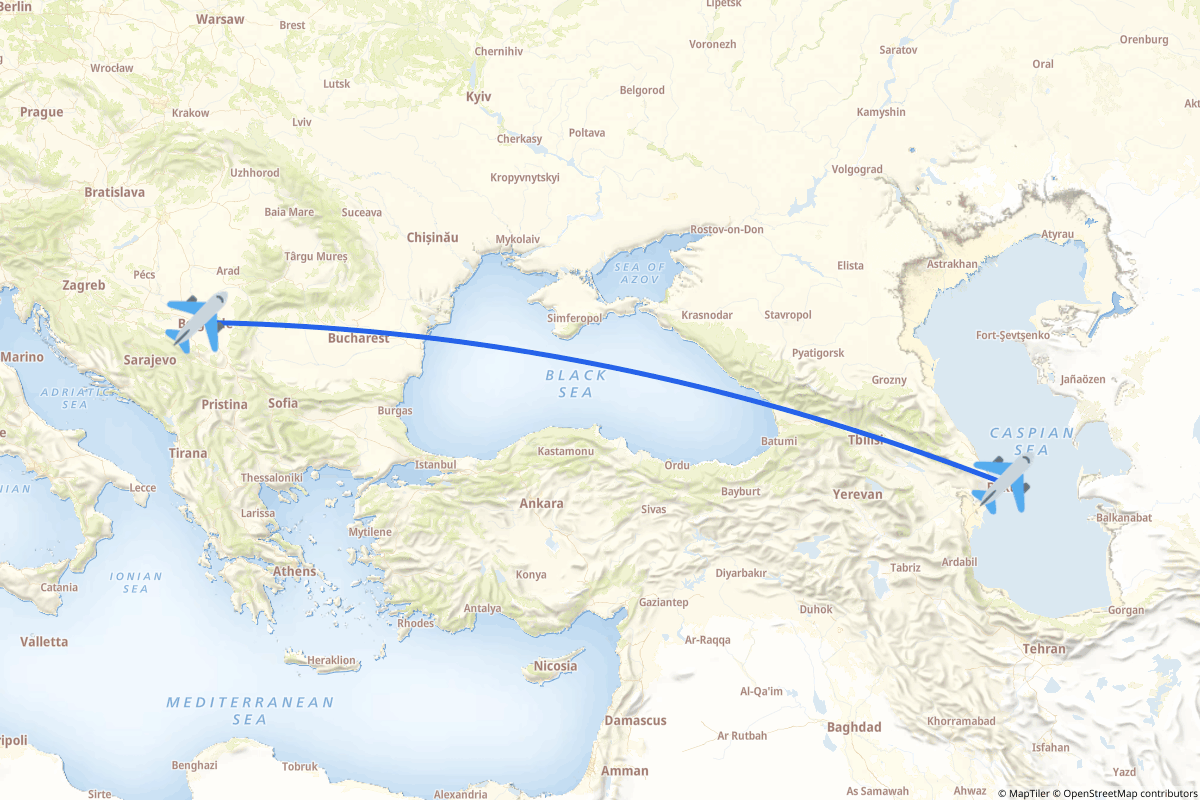
Air Serbia has launched a twice-weekly service linking Belgrade Nikola Tesla Airport (BEG) to Baku's Heydar Aliyev International Airport (GYD), marking the carrier's entry into the Azerbaijan market. The route commenced operations on May 5, 2026.
The Belgrade–Baku corridor represents a strategic expansion for the Serbian flag carrier into the South Caucasus, a region with growing trade and tourism ties to Southeast Europe. The roughly 1,400-kilometer distance translates to approximately three hours of flight time, positioning the route as a viable connection for business and leisure travelers seeking alternatives to longer routing through major European hubs.
Market Context and Connectivity
Baku serves as a major regional hub for Azerbaijan Airlines and functions as a gateway to Central Asia, the Caspian region, and onward connections to the Middle East. The addition of Air Serbia's service provides Serbian and broader Balkan passengers with a direct option to Azerbaijan's capital, previously requiring connections through Istanbul, Vienna, or other European centers. Conversely, the route offers Azerbaijani travelers direct access to Belgrade and potential onward connections within Air Serbia's network across the former Yugoslav republics and Central Europe.
Air Serbia's existing regional presence includes services to multiple Balkan capitals and select Central European cities, but the Baku launch represents a notable eastward extension. The carrier has historically focused on markets within the former Yugoslavia and nearby EU member states, making this venture into the Caucasus a departure from its traditional geographic footprint.
Operational Details
The airline has not publicly specified the aircraft type assigned to the route. Air Serbia operates a mixed fleet including Airbus A220 and A319 narrowbodies, either of which could feasibly serve the Belgrade–Baku pairing depending on demand forecasts and scheduling constraints. The twice-weekly frequency suggests a measured initial approach, allowing the carrier to assess load factors and market response before potential capacity increases.
No competing direct service currently operates on this city pair, giving Air Serbia a monopoly position on the route. This absence of direct competition may reflect limited historical demand or the relative newness of systematic air connectivity between Serbia and Azerbaijan, though both nations maintain diplomatic and economic relations.
Strategic Implications
The launch aligns with broader trends of Balkan carriers expanding eastward as European aviation networks mature and secondary markets become increasingly important for network carriers seeking growth. For Air Serbia, the route diversifies its geographic exposure and may generate feed traffic from Baku's onward connections to Central Asia and the Middle East.
Bottom line: Air Serbia's entry into the Belgrade–Baku market opens a new direct corridor in Southeast Europe–Caucasus connectivity, operating twice weekly from May 5, 2026.
Things to do at each end of the route
Top-rated tours & experiences in Belgrade and Baku.