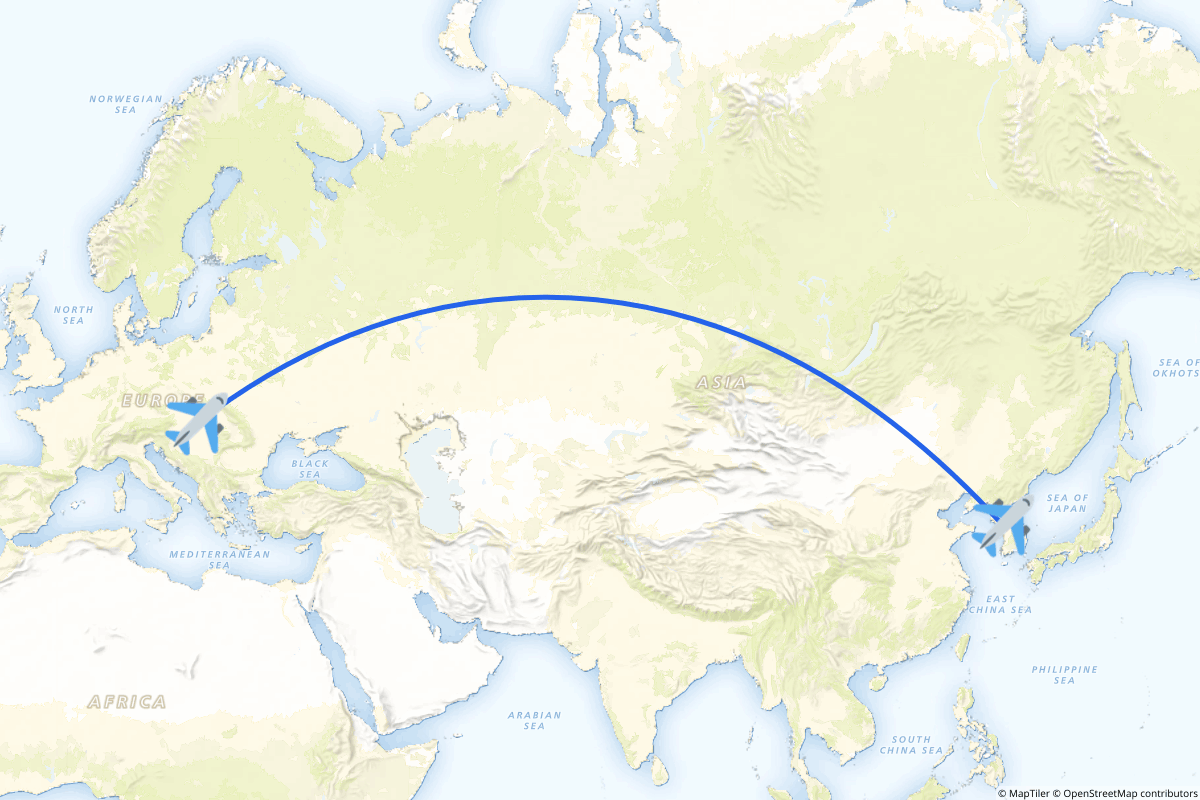
Update: Now operational. This route launched as planned and is now flying a scheduled service. The details below reflect the original launch announcement.
Asiana Airlines has announced a new nonstop route linking Incheon International Airport (ICN) in Seoul, South Korea, to Budapest Liszt Ferenc International Airport (BUD) in Hungary, with the inaugural flight scheduled for April 3, 2026.
The service will operate twice weekly, filling a gap in direct connectivity between Northeast Asia and Central Europe. This city pair matters due to growing economic ties between South Korea and Hungary, including trade in electronics, automotive parts, and pharmaceuticals. Hungary's role as a manufacturing hub for companies like Samsung and Hyundai—both with significant Korean investment—underpins demand for efficient passenger links. Pre-pandemic data showed over 50,000 annual passengers between the two countries, mostly via one-stop connections through Frankfurt or Istanbul, highlighting potential for nonstop growth.
Carrier Network and Regional Strategy
Asiana, operating under IATA code OZ and ICAO AAR, maintains a focused European network from its Incheon hub. Current destinations include Frankfurt, Munich, Rome, Paris, London Heathrow, and Istanbul, served primarily by widebody aircraft to support long-haul demands. This Budapest addition aligns with Asiana's post-merger strategy following its 2024 acquisition by Korean Air, aiming to consolidate and expand secondary European markets. The route complements Korean Air's existing ICN-BUD service via Amsterdam, potentially enabling seamless connections within the merged Star Alliance framework. Asiana's broader push into Central and Eastern Europe reflects rising tourism and business travel, with Hungary welcoming over 100,000 Korean visitors annually pre-COVID.
Aircraft and Traveler Impact
Aircraft type has not been specified, but Asiana's long-haul fleet—featuring Airbus A350-900s and Boeing 777-200ERs—likely candidates given the route's demands. The great-circle distance of approximately 8,000 kilometers (4,970 miles) suggests a flight duration of 10 to 11 hours outbound and slightly longer on the return due to headwinds, based on similar transpacific-Europe paths operated by Boeing 787s and A350s for efficiency on such sectors.
This route enhances options for travelers on the Seoul-Budapest corridor, previously reliant on European hubs with layovers of four to eight hours. Business passengers gain time savings, while leisure travelers—drawn to Budapest's thermal baths, Danube cruises, and proximity to Vienna—benefit from direct access. No direct competitors currently serve ICN-BUD; alternatives include one-stops via Lufthansa from Frankfurt or Turkish Airlines from Istanbul, both with higher frequencies but added connection risks.
Operational Details
Flights will run twice weekly, though specific days remain unconfirmed. Service launches April 3, 2026, positioning it as a spring addition amid seasonal upticks in European travel. Asiana's ICN operations already handle over 100 weekly long-haul departures, with capacity tuned to load factors above 80% on mature routes.
Bottom line: Asiana's ICN-BUD route introduces vital direct capacity to an underserved corridor, leveraging widebodies to boost Korea-Hungary links ahead of fuller network integration.
Things to do at each end of the route
Top-rated tours & experiences in Seoul and Budapest.